
Power to heal, teach and connect generations found in Indigenous storytelling
âchimo 2026 marks 150 years since signing of Treaty 6
By Paul Sinkewicz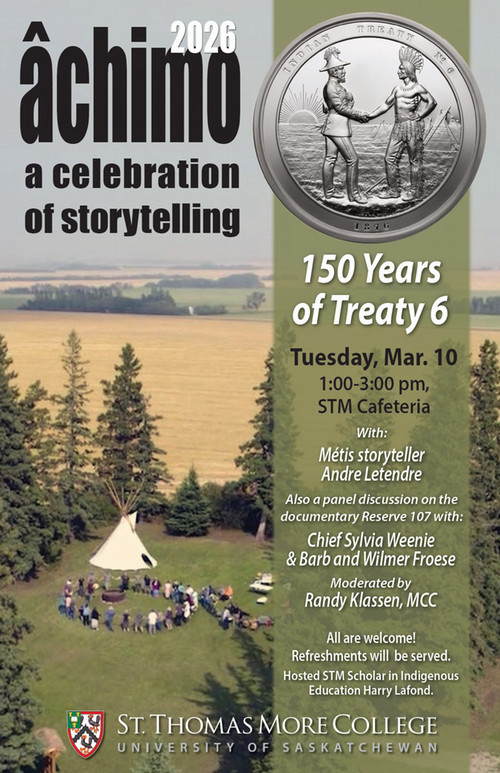
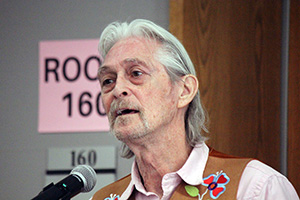
Storytelling is very special to Harry Lafond.
So much so that he brought a new type of event to St. Thomas More College (STM) in 2020 in his role as STM Scholar in Indigenous Education.
âchimo is an annual celebration of Indigenous storytelling. Over the years, the STM community has had the opportunity to listen to different types of knowledge keepers from many different backgrounds.
At the fifth edition of âchimo, Lafond related his own background as the son of a Metis woman who would share stories after the evening meal on long, cold prairie nights.
“In the Cree world, we choose the word âchimo as the title for this activity that we hold every winter, because that's when stories were the strongest in our communities, and they continue to be like that,” he said. “And that's a blessing, because it ensures then that our children and our grandchildren will hear bits and pieces of it, and hope we can generate in them a sense of curiosity about what stories Kôhkom (grandmother) has, and ask: what do they mean?”
While growing up, Lafond would listen as his mother passed on stories about family from long ago.
“She would tell us stories about her Mooshum (grandfather),” he told the audience gathered in the STM cafeteria. “Her Mooshum was the one that wandered the plains, from Winnipeg to here, and led a life that we don't understand. It was their life, and we can only enjoy it through the stories that people like my mother passed on.”
Lafond said âchimo could encompass many things.
“It could be anything. It could be entertaining, could be serious, it could be challenging. It's whatever. And I grew up in that world.”
Dr. Carl Still, president of STM College, said âchimo has become a special tradition at STM in recent years. He thanked Lafond, for bringing it to STM, and those who supported the event through STM’s Engaged Indigenization Advisory Committee.
“In a university, as you can imagine, we think a lot about how knowledge is passed from teachers to students, from one generation to another.” Still said. “And for much of our history as a Western institution, the lecture has been the standard form of teaching and learning, supplemented by the seminar at more senior levels.”
“But in recent years, we've been introduced to such things as the Talking Circle, which is a very powerful form of dialogue. And then, of course, there's storytelling, which is another way of transmitting knowledge. And then there are performances with or without words -- singing, drumming, dancing -- which we've seen in previous âchimos."
“So, in addition to different forms of transmitting knowledge and culture that we have in Western societies, we now have the privilege of experiencing Indigenous ways of sharing knowledge and culture. And these enrich the forms of teaching and learning that have been part of STM throughout our history.”
The guests at the 2026 edition of âchimo brought three different experiences on the year that marks 150 years since the signing of Treaty 6.
Andre Letendre is a storyteller who shared a lifetime of experiences navigating life as a Metis man in Saskatchewan. He generously shared his own struggles, and achievements, that led him to the front of the room at âchimo 2026 at the age of 70.
He said stories often offer one of the best medicines that we have: laughter.
“But, also with spiritual intent to them. Because with that spiritual intent, then we might get some guidance through life on how to develop ourselves,” he said.
There was also a panel discussion moderated by Randy Klassen of the Mennonite Central Committee, on the documentary Reserve 107. Speaking on the panel were Chief Sylvia Weenie, of the Stoney Knoll Cree Nation, and Barb and Wilmer Froese who farmed on land that was meant to be Reserve 107, but was taken back and given to Mennonite settlers.
Their work creating peaceful relationships despite the wrongs of the past created an inspirational framework for others working toward reconciliation.
Lafond is hopeful initiatives like âchimo can lead to even greater connection between cultures at STM.
“There's also another kind of story that we haven't touched here, except in small pieces, sometimes,” he said. “It’s atayokanak.”
“Atayokanak is a different type of story. It's that story that holds the knowledge of ceremonies, and the sacredness of the spirituality of the people. And that needs its own way of being transmitted from person to person.”
“And we may, I think, as we move forward, make room in our College to have some of these, atayokanak to be allowed by the elders and by the knowledge keepers and the ceremonial leaders, to become present in this College, so that the young people who are studying in this university, in this College, will have an opportunity to feel as if they're back home and going to a Horse Dance, or they're going to a Sun Dance. We need our collegues and our universities to be that way, and so, St. Thomas More is moving forward along that line.”