Economics professor Moshiri points to measurable benefits to be found in ethnic diversity
Irene and Doug Schmeiser Centre for Faith, Reason, Peace, and Justice Annual Lecture
By Paul Sinkewicz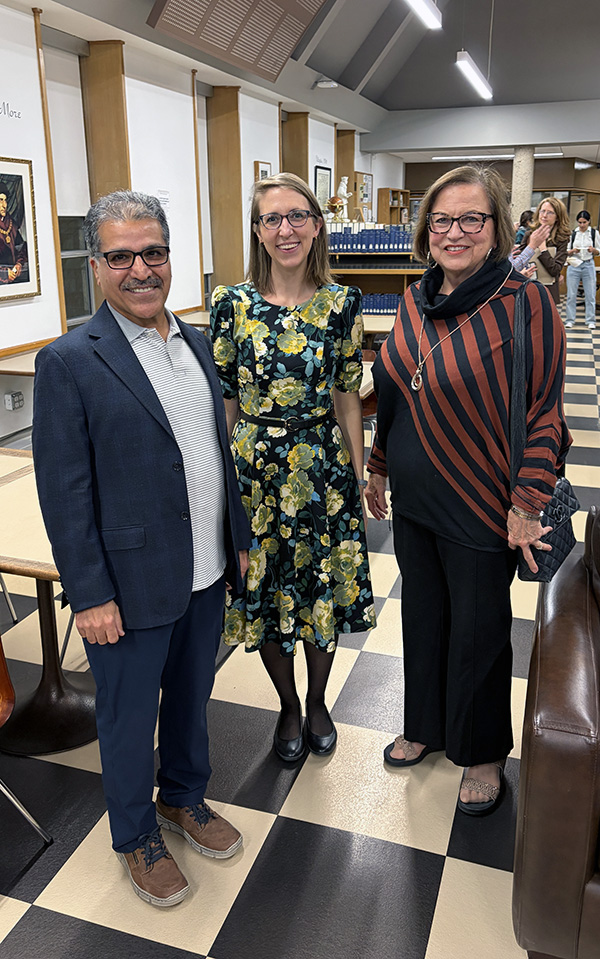
If there is one thing the field of economics knows how to do, it is to analyze the factors that lead to successful outcomes.
Leading businesses depend upon understanding the variables that could mean the difference between sustained growth or economic ruin.
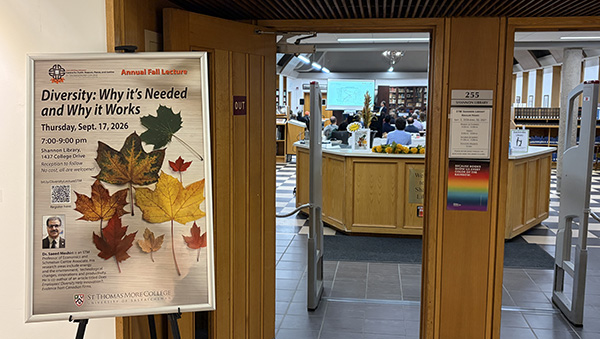
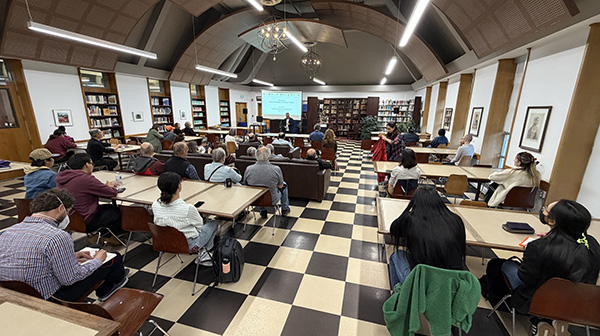
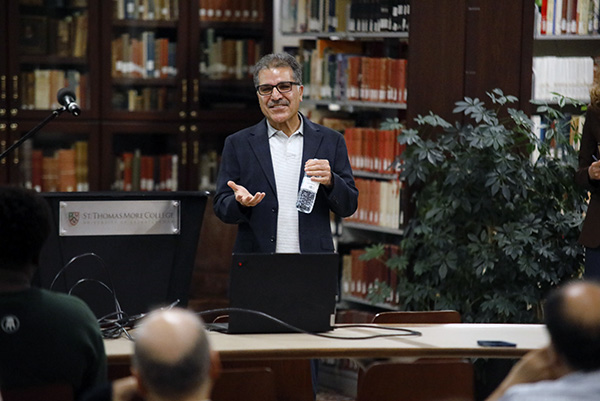
Dr. Saeed Moshiri delved into some fascinating findings that have broader implications for social justice while giving the Irene and Doug Schmeiser Centre for Faith, Reason, Peace, and Justice (CFPRJ) Annual Lecture in the Shannon Library on Thursday, Sept. 17, 2026.
Moshiri is a professor in the St. Thomas More College (STM) Department of Economics, and an associate of the CFPRJ.
His talk was titled 'Diversity: Why It's Needed and Why It Works', and he demonstrated how ethnic diversity in the workforce leads to better results in innovation, production and problem-solving.
Moshiri showed that a collection of people with diverse perspectives and heuristics (shortcuts of rules of thumb) can outperform a collection of people who rely on homogeneous perspectives and heuristics.
And that a random collection of intelligent problem solvers can outperform collections of the best individual problem solvers.
He also showed that even when individual predictions may not be accurate, collections of diverse, inaccurate predictions can be.
Insights like this have implications for social justice in our wider society and serve the goal of the lecture series sponsored by the Centre.
“After several years of bringing speakers from all over the continent to this lecture series, last year we decided to put out an invitation to the Centre’s affiliates and associates to ask what they might have to offer,” said Dr. Cynthia Wallace, Director of the Centre. “And so, when Dr. Saeed Moshiri proposed this lecture the committee was delighted.”
“It gives us a chance to shine a light on some of the good work that’s happening closer to home.”
CFRPJ has three different mandates, said Walace. Its first is to oversee academic programming in our distinctive areas of Peace Studies, Catholic Studies, and Critical Perspectives on Social Justice and the Common Good.
The Centre also works to foster educational and scholarly partnerships with community organizations working at those intersections of faith, reason, peace, and justice.
And the third mandate is to grow a network of affiliated and associated scholars and community practitioners who work at those intersections.
“Tonight’s lecture continues a tradition some of us began in very scrappy ways with a Peace Studies lecture that actually began in this library, and since then the lecture has expanded to rotate among our distinctive areas. So, we’ve had lectures on Catholic studies, and peace studies, and tonight our focus is more oriented toward social justice and the common good,” said Wallace. “All of those things for the good of the world.”